Categories
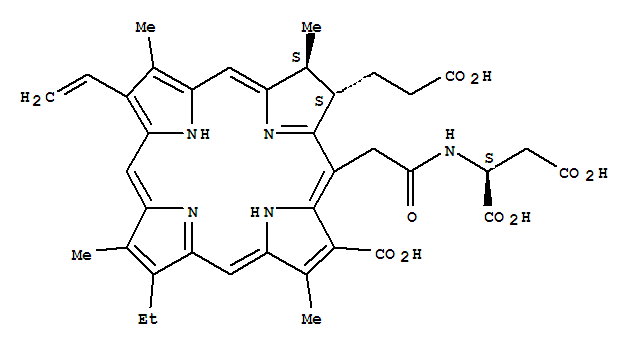
monoaspartyl chlorin e6
- CAS: 110230-98-3
- Purity: 99%
- Buy high quality and low price monoaspartyl chlorin e6 110230-98-3 now
Buy high quality and low price monoaspartyl chlorin e6 110230-98-3 now We provide high quality monoaspartyl chlorin e6 (CAS 110230-98-3), at a very affordable prices to our customers.
1.What is the monoaspartyl chlorin e6 ?
In collaboration with Light Sciences Corp. and Meiji Seika Kaisha, Nippon Petrochemicals has developed and launched the injectable photosensitizer talaporfin sodium in Japan for the photodynamic therapy (PDT) of cancer. The initial approval is for the treatment of early stage lung cancer, but Light Sciences Corp. and its subsidiaries are also developing talaporfin sodium for other hyperproliferative diseases, such as, liver metastases arising from colorectal cancer, wet age-related macular degeneration, and atherosclerosis. Talaporfin sodium is typically supplied as a lyophilized green powder, and it is synthesized via a carbodiimide-mediated coupling of chlorin e6 (obtained from precursors that were extracted from natural sources) with L-aspartic acid. Since chlorin e6 contains three carboxylic acid groups, the coupling reaction produces a mixture of aspartic acid conjugates. The desired site of conjugation is the acetic acid side chain of C-20, and the other regioisomers are removed by chromatographic purification. Compared to other photosensitizers, talaporfin sodium is associated with minimal cutaneous photosensitivity, is activated at long wavelengths permitting deeper tissue penetration, and requires a shorter interval between intravenous administration and photoactivation. It has a serum half-life of nine hours and is excreted unmetabolized, predominantly by the biliary system. In the clinical study of patients with early lung cancer, a complete response was obtained in approximately 86% of the lesions (administration at 40 mg/m2 followed by laser irradiation at 100 J/cm2, 4–6 hours later). In addition to laser activation, a clinical study involving a variety of refractory solid tumors demonstrated that intratumoral delivery of light-emitting diodes was effective; a 33% overall response rate was observed with no cutaneous phototoxicity. Regardless of the mode of activation, the outcome is the same; the activated photosensitizer reacts with endogenous oxygen to generate singlet oxygen that ultimately leads to apoptosis and vascular ischemia of the targeted tissue. The most significant adverse effect associated with talaporfin sodium was generalized cutaneous photosensitivity, and erythema and oedema were common as well. Individual cases of nausea, vomiting, diarrhea, heartburn, headache, and pruritus were also reported.
Talaporfin is a photosensitizer used in photodynamic therapy.
2.What is the CAS number for monoaspartyl chlorin e6 ?
The CAS number of monoaspartyl chlorin e6 is 110230-98-3.
More information of monoaspartyl chlorin e6 110230-98-3 are:
|
CAS?Number |
110230-98-3 |
|
Density |
1.359 g/cm3 |
|
Boiling Point |
1218.1 °C at 760 mmHg |
|
Flash Point |
690.5 °C |
|
Vapor Pressure |
0mmHg at 25°C |
|
Refractive Index |
1.64 |
|
PSA |
238.09000 |
|
LogP |
3.52610 |
3.What is the molecular formula of monoaspartyl chlorin e6 ?
The chemical formula of?monoaspartyl chlorin e6 is C38H41N5O9 which containing 38 Carbon atoms,41 Hydrogen atoms,5 Nitrogen atoms and 9 Oxygen atoms,and the molecular weight, and the molecular weight of monoaspartyl chlorin e6 is 711.76
4.What is monoaspartyl chlorin e6(110230-98-3)used for?
In collaboration with Light Sciences Corp. and Meiji Seika Kaisha, Nippon Petrochemicals has developed and launched the injectable photosensitizer talaporfin sodium in Japan for the photodynamic therapy (PDT) of cancer. The initial approval is for the treatment of early stage lung cancer, but Light Sciences Corp. and its subsidiaries are also developing talaporfin sodium for other hyperproliferative diseases, such as, liver metastases arising from colorectal cancer, wet age-related macular degeneration, and atherosclerosis. Talaporfin sodium is typically supplied as a lyophilized green powder, and it is synthesized via a carbodiimide-mediated coupling of chlorin e6 (obtained from precursors that were extracted from natural sources) with L-aspartic acid. Since chlorin e6 contains three carboxylic acid groups, the coupling reaction produces a mixture of aspartic acid conjugates. The desired site of conjugation is the acetic acid side chain of C-20, and the other regioisomers are removed by chromatographic purification. Compared to other photosensitizers, talaporfin sodium is associated with minimal cutaneous photosensitivity, is activated at long wavelengths permitting deeper tissue penetration, and requires a shorter interval between intravenous administration and photoactivation. It has a serum half-life of nine hours and is excreted unmetabolized, predominantly by the biliary system. In the clinical study of patients with early lung cancer, a complete response was obtained in approximately 86% of the lesions (administration at 40 mg/m2 followed by laser irradiation at 100 J/cm2, 4–6 hours later). In addition to laser activation, a clinical study involving a variety of refractory solid tumors demonstrated that intratumoral delivery of light-emitting diodes was effective; a 33% overall response rate was observed with no cutaneous phototoxicity. Regardless of the mode of activation, the outcome is the same; the activated photosensitizer reacts with endogenous oxygen to generate singlet oxygen that ultimately leads to apoptosis and vascular ischemia of the targeted tissue. The most significant adverse effect associated with talaporfin sodium was generalized cutaneous photosensitivity, and erythema and oedema were common as well. Individual cases of nausea, vomiting, diarrhea, heartburn, headache, and pruritus were also reported.
InChI:InChI=1/C38H41N5O9/c1-7-20-16(3)24-12-26-18(5)22(9-10-32(45)46)35(42-26)23(11-31(44)41-30(37(49)50)15-33(47)48)36-34(38(51)52)19(6)27(43-36)14-29-21(8-2)17(4)25(40-29)13-28(20)39-24/h7,12-14,18,22,30,39-40H,1,8-11,15H2,2-6H3,(H,41,44)(H,45,46)(H,47,48)(H,49,50)(H,51,52)/b24-12-,25-13-,26-12-,27-14-,28-13-,29-14-,35-23-,36-23-/t18-,22-,30-/m0/s1
Relevant articles related to monoaspartyl chlorin e6:
5.Buy high quality and low price monoaspartyl chlorin e6 110230-98-3 now
Xi'an SENYI New Material Technology Co., Ltd is a quality supplier of monoaspartyl chlorin e6. Our main goal is customer satisfaction. Contact us to negotiate the best price for your business on monoaspartyl chlorin e6 110230-98-3.